
Story
Plot
Narrative



Have your say
» What makes a plot worth telling?
» Plot first, or narrative first?
» What is transformation in a character?
» Does everything have to have a purpose in narrative storytelling?
From the Collection
How to use a story to give additional meaning to a plot
Anna Karenina, Tolstoy (Leo), 1878
Multidimensional characters may have inner dimensions that are at odds (cohesion/contradiction factor) with those that motivate them in their public life (explicit objectives and strategy).

An example of the narrative role of a secondary character
Nineteen Eighty-four (1984), George Orwell, 1946
The story of a character provides the cohesion that binds them to another character of the plot.

Six steps from an initial idea to plot and narrative
Cyrano de Bergerac, 1897, a play by Edmond Rostand.
We propose here to go through all the stages of the narrative creative process, from the initial idea to the specific contributions of a narrating agent to the narrative, illustrating them with examples taken from Cyrano de Bergerac.
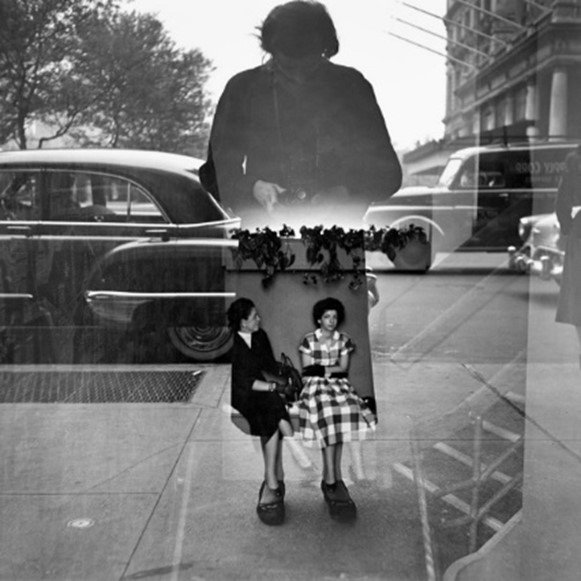
Humor and underlying emotions
Photo by Vivian Maier, Chicago, date unknown.
Visual distanciation can be a form of humorous first-person commentary.

How to convey the inner world of a character
Of Mice and Men, John Steinbeck, 1937.
The retention factor can be applied to an event to convey elements of characterization.

Plausibility in a supernatural world
Ratatouille, written by LEWIS (Brad), 2007
Animated films and comic strips are laboratories for the treatment of believability. They allow us to push the limits of reality and the truths that a narrating agent believes they can deduce.
More models from the Collection »
FAQ
Who is This Website for?
Anyone interested in telling stories.
And it is not necessary to study narratology first before exploring this site!
The purpose is not the theory of narratives but to address the process of creating narratives.
The theoretical jargon has been adapted and ideas are described in everyday language and illustrated with numerous examples.
What is the Theoretical Framework for What is Presented Here ?
Some terms and concepts are specific to this site. They appear in italics.
Many others are borrowed from narratology.
Some come from academic and critical studies on theater, cinema, comics and fine arts.
Recent findings in neuroscience have opened up new avenues on the theory of reception that have inspired my approach to narrative arts.
Definitions and a list of sources can be found in the glossary.
Is it Necessary to Learn How to Create a Narrative?
You don’t need to.
To narrate is a human instinct.
Therefore, it is possible to create a perfect narrative work, and to have it recognized as such, without ever having encountered the lessons shared on this site.
It may help you to shorten the trial and error process though.
What is the Point of Bringing Together Different Modes of Expression Under the Heading of "Narrative Arts"?
Although their “materials” are different (words, sounds, images in two or three dimensions, fixed or animated, physical or immaterial) these modes of expression have a common objective: the complete or partial representation of an event in time.
Their processes and strategies are different, but not always incompatible (“interoperability”).
Comparing and transposing their techniques can generate new possibilities.
To give an example, early cinema was influenced by theater and literature (e.g. George Meliès and Jules Verne), but cinema came in turn to have a productive influence on them (The Lost Generation, Le “Nouveau roman”, etc.).
Why a Website?
Public hypertext and hypermedia are means of communication that perfectly suit the philosophy of this site, which aims to be a place of exchange and debate with interactive and evolving content and the regular publication of new articles, updates and revisions, of which subscribers will be informed by e-mail.
What is this Website Not?
A rallying place for literary happy few, an academic textbook, a critical anthology, a new writing “how to”, a recipe book, a polemical blog, a guru’s platform.
About

I drew the material for this site from notebooks accumulated over a thirty-year career as a scholar (doctoral thesis on American screenwriters – Paris 1 Panthéon-Sorbonne), teacher and writing coach (founding professor of the Met Film School in London), consultant to film producers and distributors (France, Germany, England, Switzerland, the U.S.A.), and on occasion, television and film screenwriter.
I have the privilege of coaching writers from five continents. They entrust me with their singular stories and plots, rich in their own cultural specificities, and allow me to observe on a daily basis the universality of the effects produced by narratives.
Philippe Longchamp
Contact : phil@phlglobal.net
(Photo Paul Chovet)
